Last updated:
Your favourite finfluencer’s content might sound good, but you should still run some checks before you commit your money.
What are finfluencers?
Financial influencers (aka 'finfluencers') discuss financial products and services online through social media platforms and/or a website. Their content tends to be highly relatable, with personal stories relating to their finances paired with curated imagery of their lives. Some finfluencers are hobbyists; for some it’s their career.
Finfluencers can be engaging and easy to access – for example, nearly two-thirds of Gen Z use social media to make decisions about their financial future. But popularity doesn’t equal credibility. Content may oversimplify risks, exaggerate potential returns, or simply not be right for your situation.
So, before you believe all the information, or follow advice you see and hear on social media, podcasts and online forums, it’s important to critically assess what you’re seeing. Ask the right questions to decide whether the information is credible and right for you — or whether to ignore it.
Information or advice?
When you’re planning your finances and investments, it’s important to recognise whether you’re being given information or financial advice. A lot of finfluencers provide financial information – but some also provide advice. And some may encourage you to join a private trading channel (for example, on Telegram) to provide advice away from the public eye.
- Financial information is useful facts about products, services and financial strategies. It’s usually free and available from many places. A licence isn’t needed to provide factual information.
- Financial advice is a recommendation or opinion about a financial product or type of financial product. People who give financial advice must hold an Australian Financial Services (AFS) licence.
Learn more about the difference between financial information and financial advice.
If a finfluencer isn’t licensed, an authorised representative or exempt, it is unlawful for them to provide financial advice in Australia. You can check out a finfluencer’s credentials by using ASIC’s professional registers search.
If you know of a finfluencer who is providing advice and their name doesn’t appear on the register, report them to ASIC.
What do finfluencers talk about?
It can be anything from rewards point hacks to risky investments!
Recent surveillance by ASIC found that financial products like shares, exchange traded funds (ETFs) and leveraged derivatives were popular topics of choice by the finfluencers being tracked. Others discuss personal finance more generally, covering financial products such as bank accounts, superannuation and insurance.
Some finfluencers might position themselves as 'trading experts', promoting trading in high-risk, complex products such as CFDs and FX, or investing in crypto-assets. Sometimes, social media content that uses images of lavish lifestyles, sportscars and other luxury goods to promote a financial product or trading strategies contained misleading or deceptive representations about the prospects of success. If it sounds too good, to be true, it probably is.
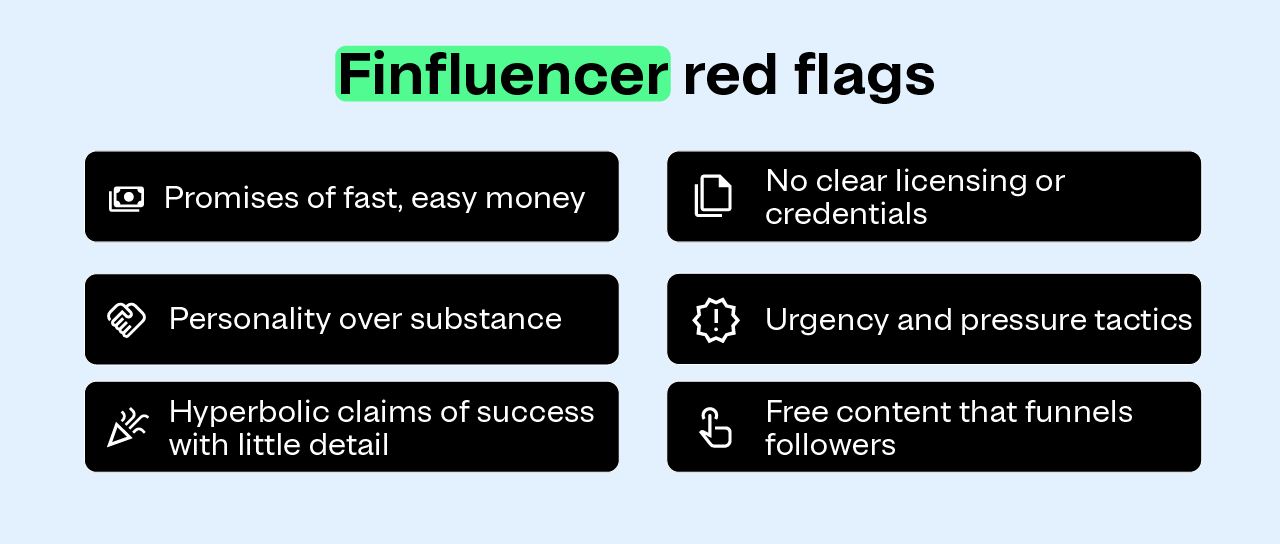
Check a finfluencer's claims
If you’re considering investing in something everyone is talking about, do your own checks first. Make sure you invest in facts. If a finfluencer is promoting specific shares, crypto, financial strategies or other financial products, ask yourself the following questions.
Checklist
check_box Understand how the investment works
- Can I explain how this investment makes money?
- Can I explain the main risks of this investment?
- Have I read the prospectus or product disclosure statement, if there is one?
If you don’t understand it, don’t invest yet.
check_box Check credentials and legitimacy
- Is the finfluencer licensed by ASIC to advise on or offer an investment?
- Have I checked ASIC's Professional Registers Search for details of their AFS licence?
Only use reputable financial information. If there’s no AFS licence, or the details don’t match, don’t invest.
check_box Check for paid promotions
- Is this a sponsored post?
- Does the finfluencer earn commission or other benefit if I sign up?
Always ask: what’s in it for them?
check_box Find independent information
- Have I searched for critical reviews?
- Are there regulator warnings?
- Have I searched the investor alert list?
- Is there balanced media coverage?
If there’s no reputable independent information, that’s a warning sign.
check_box Consider what you can afford to lose
Be honest with yourself:
- If I lose money on this investment, can I still pay my rent, mortgage and/ or bills?
- Am I using savings I need soon?
- Am I borrowing to invest?
Be extra cautious with money you cannot afford to lose.
check_box Consider why you want to invest
Ask yourself:
- Would I still invest if no one else was talking about it?
- Does this fit my long-term goals?
- Or am I just scared of being left behind?
Slow and steady investing is normal. Most wealth builds over time, not overnight.
Remember: Finfluencers might make it sound like a great idea to invest, but that doesn’t mean it’s right for you. If you’re unsure, consider seeking guidance from a licensed financial adviser or using trusted resources like Moneysmart to help you make informed decisions.