Last updated:
If your super fund has made a mistake, taken too long to deal with a request, or you’re unhappy with the service you've received, you can complain.
Why it’s worth complaining
Your super could be one of your most important financial assets. The decisions your super fund makes today can affect your retirement savings and future financial wellbeing for years to come. If something goes wrong, speaking up can help get your issue resolved and make sure you receive the service you're entitled to.
It can also alert the super fund to a problem that might be affecting other account holders as well.
Making a complaint takes time but it doesn’t have to be difficult. There are free and independent services to help you and we’ve linked to these below.
Have a complaint that’s not super-related? Read our general guidance on how to complain.
Why people complain about their super fund
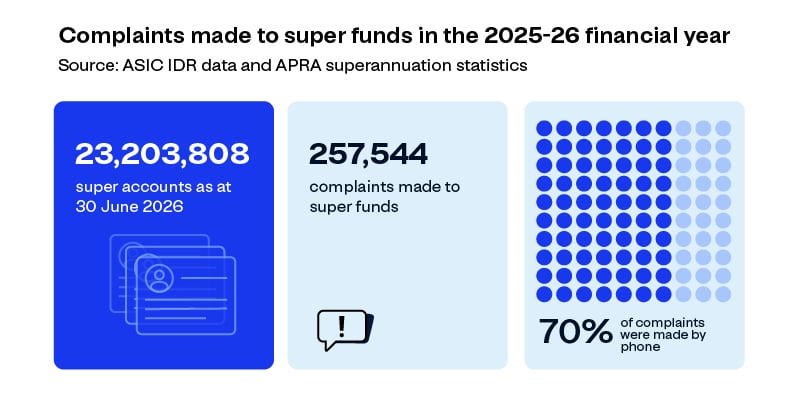
ASIC has stated that over the 2025-26 financial year, across 45 superannuation trustees, more than 250,000 complaints were made about super.
You can complain about a wide range of issues, including if your super fund:
- takes too long to process a payment or request
- makes a mistake with your account
- does not respond to you within a reasonable time
- gives poor customer service
- handles an insurance claim incorrectly
- does not follow your instructions
- charges incorrect fees
- gives you incorrect information or advice
The process to follow to complain
Contact your super fund
If the problem is simple, you may be able to resolve it with a phone call or online chat.
ASIC has noted that 70% of the 250,000 complaints made in the 2025/26 financial year were made by phone.
You also have the option to contact your super fund by writing to them. This can be a good idea if your complaint is more complex or relates to an insurance claim. Some super funds provide an option to submit a complaint online.
Your super fund’s website should have information on the ways in which you can make a complaint.
Outline your concerns
When you contact your fund, explain:
- what happened
- when it happened
- how it has affected you
- what outcome you would like.
Have your member number handy so the fund can quickly locate your account.
Also consider if it would be helpful to send your super fund copies of any emails, letters, screenshots or other documents that support your complaint. Providing as much relevant information as possible can help your fund investigate and resolve the issue more quickly.
Be clear about the outcome you would like
For example, you may want the fund to:
- correct an error
- process a request
- explain a decision
- apologise
- compensate you for a loss caused by their mistake.
If there is some urgency to your complaint, for example it is about a payment request where the payment is needed quickly, make this known when raising your concerns.
If you made your complaint by phone and would like a written response to your complaint, you have the right to ask for one.
Wait for your super fund to respond
Super funds must have an internal dispute resolution process.
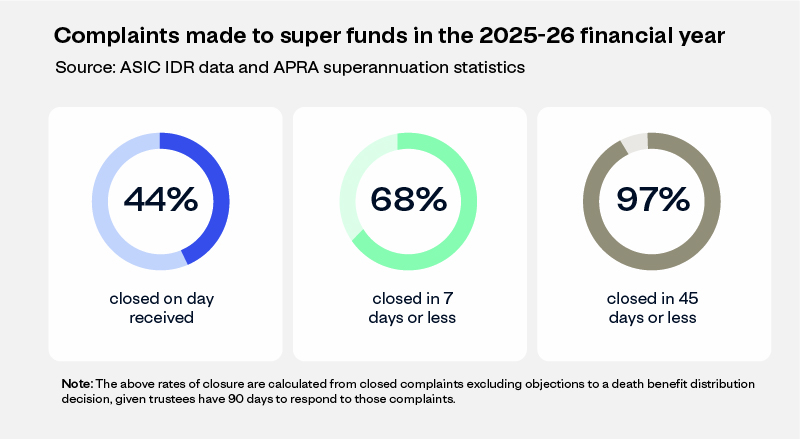
The fund should acknowledge your complaint promptly, ideally within one business day of receiving it.
For most types of complaints, a superannuation fund must provide a response within 45 calendar days. Some complaints, such as those which are particularly complex or about who receives payment of a member’s benefit after death, can take longer.
If your complaint is resolved within the first 5 business days, funds are generally not required to provide you with a written response unless you ask for one.
You can escalate your complaint
You can complain to the Australian Financial Complaints Authority (AFCA) if:
- you're unhappy with your fund's response or
- your fund doesn't respond within the required timeframe
AFCA is a free and independent dispute resolution service that helps consumers resolve complaints about financial products and services, including superannuation.
They accept complaints in various ways, including online, and offer support services and information in other languages.
Does your complaint involve a scam?
If your complaint involves a scam, act fast. Contact your fund immediately and let them know of your concern, using the official contact methods stated in your fund’s website. Then contact Scamwatch.
Act fast if you suspect a scam
Scamwatch, run by the National Anti-Scam Centre (NASC), collates information about all scam types. They use this information to warn and protect the public. Scamwatch also sends information to other agencies, including ASIC and ReportCyber, to help stop scammers. Report all scams, including superannuation scams, to Scamwatch.