Last updated:
Bonds can provide a regular source of income and help to diversify your investment portfolio.
What is a bond
When you invest in a bond, you’re lending money to a company or government for a set period of time. In return, you receive regular interest payments, called coupon payments. At the end of the bond’s term, known as its maturity date, the issuer generally repays the bond’s face value (or principal).
Bonds are generally viewed as a defensive asset and considered to be lower risk than growth assets like shares and property.
Bonds can usually be bought and sold before they reach maturity. This means a bond has a market price, which can be higher or lower than its face value.
What affects the market price of a bond
Bonds are not risk free. The market price of a bond can rise or fall depending on factors including:
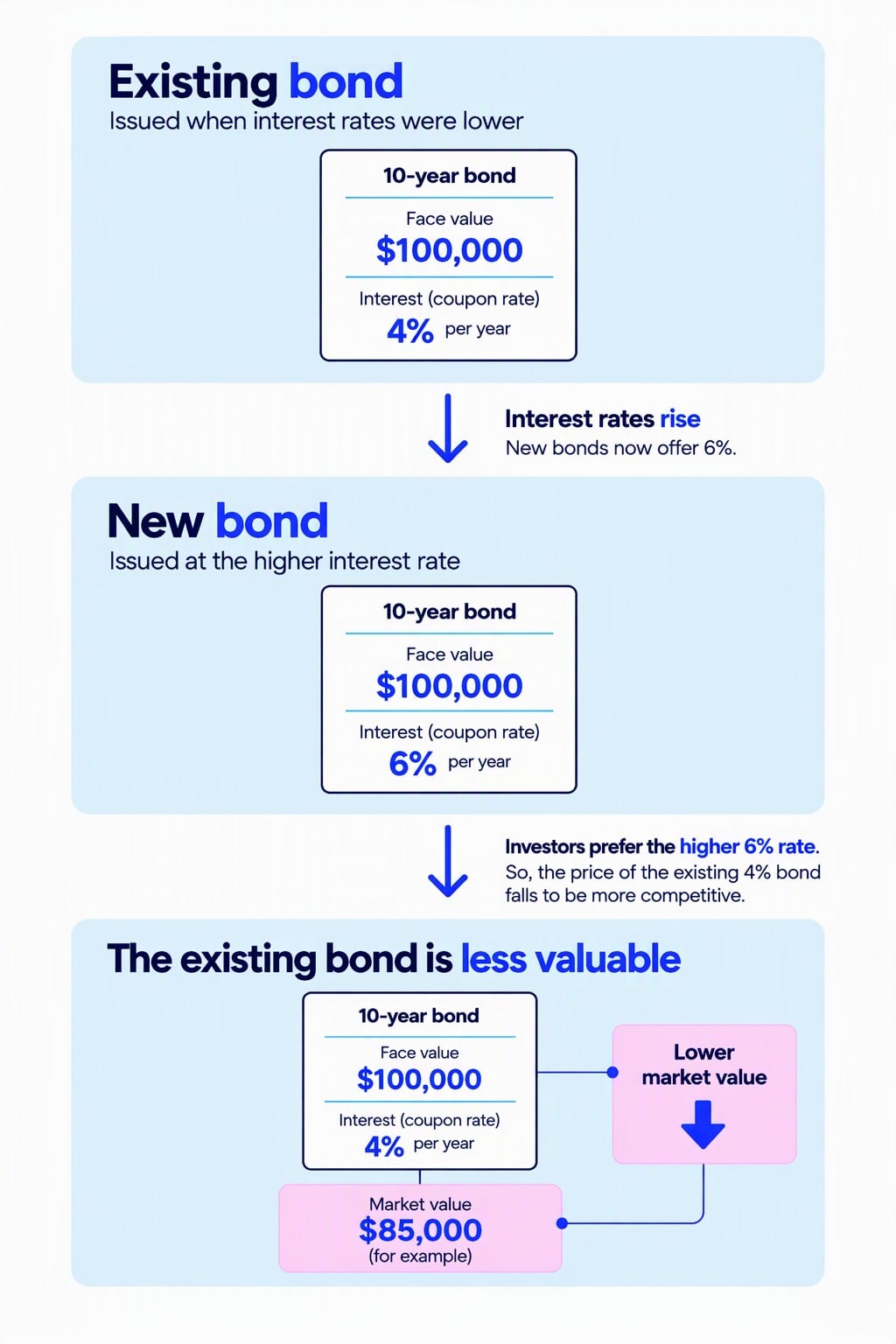
- Interest rate risk. Changes in interest rates can affect a bond’s market value. When interest rates rise, the price of existing fixed-rate bonds will generally fall.
- Credit risk. The issuer may not be able to make interest payments or repay the bond when it is due.
- Liquidity risk. You may not be able to sell a bond quickly or for the price you expect.
How interest rate changes can affect the value of existing bonds
Changes in the official cash rate, and therefore interest rates, can affect the market value of an existing bond. That’s because when interest rates rise, investors can now buy new bonds that pay a higher yield. So, the amount they would be willing to pay for a bond with a lower yield will be less.
Here’s a simplified example of what might happen to the market value of a 10-year bond paying 4% interest, if interest rates rose by 2%.
Types of bonds
In Australia, bonds are issued by the Australian Government, State and Territory governments, and by companies. How you buy and sell a bond depends on the type of bond it is.
Australian government bonds are debt securities, also known as Treasury bonds, which finance the operations of the Australian government. The government guarantees interest payments and the return of principal at maturity.
Currently Australia holds a AAA sovereign credit rating, which is the highest possible and indicates the issuers extremely strong chance of meeting its financial obligations. There are two main types of bonds:
- Treasury bonds which pay a fixed rate of interest every six months.
- Treasury indexed bonds which have payments linked to inflation.
Semi - Government bonds are debt securities, also known as Semis, which are issued by the state and territory governments via central borrowing authorities such as the NSW Treasury Corporation or Treasury Corporation of Victoria.
Their return is usually higher than Australian Government bonds given the higher risk due to being backed by a state government rather than federal. Credit ratings vary across the states and territories, currently from AAA to AA.
In addition to fixed rate and inflation linked, Semis also issue floating rate notes where the interest rate periodically adjusts based on a benchmark.
Company issued bonds, also known as corporate bonds, are issued by large companies. The market consists of non-government borrowers such as banks, financial institutions and non-financial companies. The companies may be from offshore.
There are more types of corporate bonds than the other issuers, and the range of credit ranking is also wider reflecting higher risk.
Check the credit rating before you invest
A bonds credit rating is an assessment by a credit rating agency of how likely the bond issuer is to pay interest and repay the bond’s face value when it is due. A higher rating generally means lower credit risk.
There are three major ratings agencies, namely:
Before you invest in a bond, look for the credit rating of the issuer from at least one of those providers.
Credit ratings range as follows:
| Agency | Highest rating | Lowest rating |
| Moody's | Aaa | C |
| Fitch | AAA | D |
| S&P Global | AAA | D |
Lower-rated bonds generally carry more credit risk and may offer a higher return to compensate. Before you invest, consider whether the potential return is worth the extra risk that the issuer may not make interest payments or repay your money.
How to trade bonds
Most bonds aren't bought and sold on an exchange like the ASX. Instead, they are traded directly between buyers and sellers on an over-the-counter (OTC) market.
OTC-traded bonds usually have a minimum parcel size are only available to wholesale or institutional investors. You need to use a broker or dealer to buy or sell them. The bonds are required to be held by a licensed custodian until they mature or you decide to sell them.
The ASX provides access to interests in Australian Government bonds and some corporate bonds, with no minimum parcel size. You buy them through an ASX broker as CHESS Depository Interests and brokerage fees may apply.
You may also have money invested in bonds without being aware of it, through your superannuation fund or through other managed funds that you hold.
Scammers impersonate legitimate financial services businesses and offer fake bonds. Be particularly cautious if someone claims to offer Treasury Bonds, which can only be issued by the Australian Government.
Find out how to identify an imposter bond scam and what actions you can take to verify that an offer is genuine.
How bond interest payments work
The interest you receive from a bond depends on how its interest payments are structured. Common types include:
| How interest works | What this means for you | |
| Fixed rate bond | Interest rate is set when the bond is issued and stays the same until maturity | You receive fixed coupon payments. Changes in market interest rates can affect the bond's market price. |
| Floating rate bond | The interest rate can rise or fall based on changes in a benchmark interest rate. | Your coupon payments can rise when the benchmark rate rises and fall when it falls. |
| Indexed bond | The bond's capital value is adjusted for inflation. Interest is paid at a fixed rate on the adjusted capital value. | Your interest payments and the amount repaid at maturity can change with inflation. |
Compare bond returns
A bond's yield helps you understand the return you could receive and compare it with other bonds.
One simple measure is the current yield:
Current yield = annual coupon payment ÷ current market price × 100
For example, a bond with a $100,000 face value and a 4% coupon pays $4,000 interest a year. If you buy it for $95,000:
$4,000 ÷ $95,000 × 100 = 4.21% current yield
Current yield only measures the income you receive compared with the price you pay. It doesn't take into account any gain or loss between the price you pay and the amount you receive when the bond matures.
Finding the right investments can be challenging. If you need some help to build a diversified portfolio, talk to a financial adviser.
Join thousands of Australians and get tools, tips and calculators to help with your money - straight to your inbox each month.
Sign up